Keyword research is the foundation of SEO success—but most small business owners either skip it entirely or waste hours on the wrong approach.
I’ve spent the last five years running SEO for multiple small businesses, and I’ve made every mistake possible with keyword research. I’ve chased high-volume keywords I could never rank for. I’ve optimized for keywords that got zero traffic. I’ve wasted months creating content for keywords that didn’t convert.
But I’ve also figured out what actually works.
This guide shows you exactly how to do keyword research in 2026 using a proven process that’s helped me grow organic traffic from zero to 50,000+ monthly visitors. No fluff, no theory—just the step-by-step system I use every single day.
Why Keyword Research Matters (More Than Ever in 2026)
Here’s what happens when you skip keyword research:
❌ You write content nobody searches for ❌ You target keywords that are impossible to rank for ❌ You waste time and money on content that gets zero traffic ❌ Your competitors outrank you because they did their homework
Here’s what happens when you do keyword research right:
✅ Every article targets keywords people actually search for ✅ You focus on keywords you can realistically rank for ✅ Your content attracts visitors who are ready to buy ✅ Your organic traffic compounds month after month
The difference between businesses that succeed with SEO and those that fail? Keyword research. That’s it.
The Tools You Need
Before we dive in, you need one tool: a keyword research platform.
You could try doing this with free tools, but you’ll spend 10x longer for worse results. Free tools don’t show search volume, keyword difficulty, or competitive data. You’re essentially guessing.
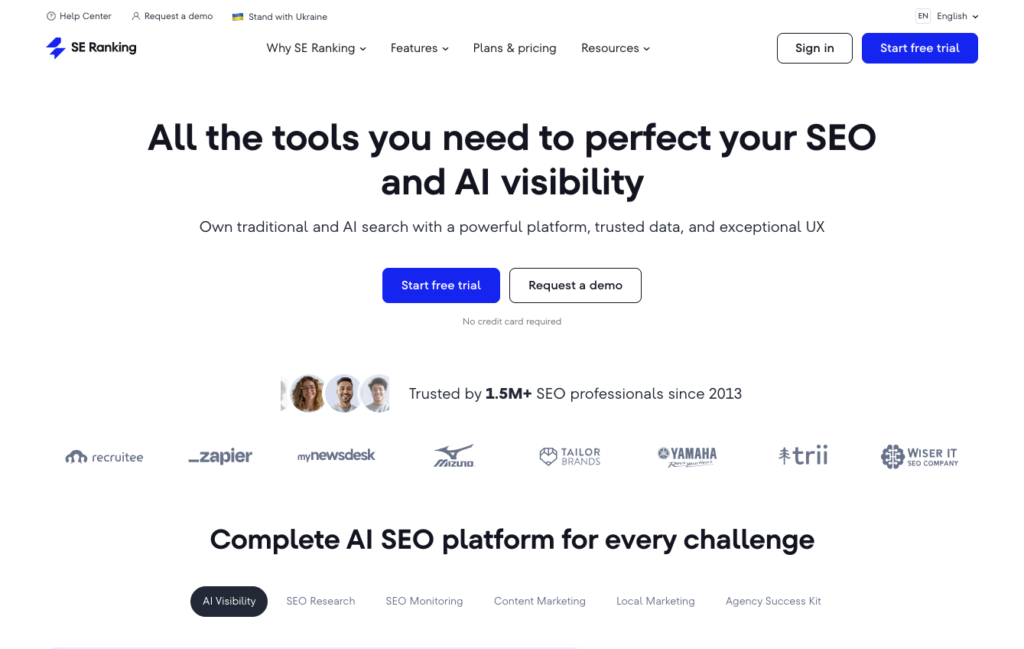
After testing every major SEO tool, SE Ranking delivers the best combination of accurate data, ease of use, and affordability for small businesses. At $65/month, it’s less than half the price of competitors like SEMrush ($139.95/month) or Ahrefs ($129/month).
What you get:
- Accurate search volume data
- Keyword difficulty scores
- Related keyword suggestions
- Competitor keyword analysis
- SERP analysis
- Unlimited searches (on Pro plan)
Try SE Ranking free for 14 days → (No credit card required)
For this tutorial, I’ll show you exactly how I use SE Ranking to find profitable keywords. The same process works with other tools, but SE Ranking’s interface makes it significantly faster.
Step 1: Brainstorm Seed Keywords (15 Minutes)
Seed keywords are your starting point—broad terms related to your business.
How to find seed keywords:
Method 1: Think Like Your Customer What would someone search for when looking for your product/service?
Example (coffee shop):
- “coffee shop”
- “espresso”
- “cold brew”
- “latte”
- “coffee near me”
Example (hair salon):
- “hair salon”
- “haircut”
- “hair color”
- “balayage”
- “hair stylist”
Example (plumber):
- “plumber”
- “drain cleaning”
- “water heater repair”
- “emergency plumber”
- “pipe repair”
Method 2: Look at Your Products/Services List every product category or service you offer.
Coffee shop example:
- Espresso drinks
- Cold brew
- Pastries
- Breakfast sandwiches
- Meeting space rental
Hair salon example:
- Women’s haircuts
- Men’s haircuts
- Hair coloring
- Highlights
- Extensions
Method 3: Check Competitor Websites Look at competitor navigation menus and service pages. These reveal their main keyword targets.
Method 4: Use Google Suggest Type your main topic into Google and see what autocompletes:
- “coffee shop with…”
- “best hair salon for…”
- “how to choose…”
Action Step: Write down 10-20 seed keywords. Don’t overthink it—you’ll expand these in the next steps.
Step 2: Expand Your Keyword List (30 Minutes)
Now we take those seed keywords and find hundreds of related keywords people actually search for.
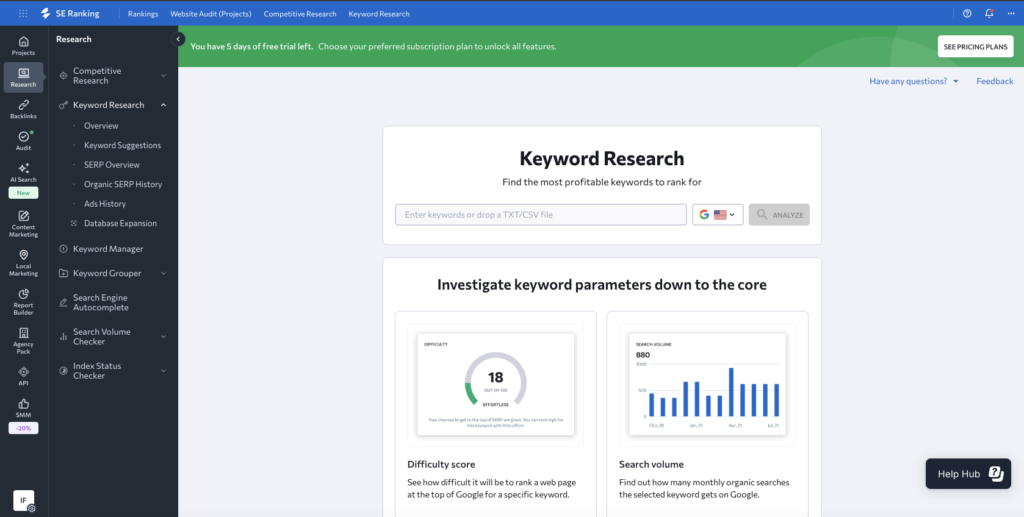
Using SE Ranking’s Keyword Research Tool:
- Log into SE Ranking →
- Go to: Keyword Research → Keyword Research
- Enter your seed keyword (example: “coffee shop”)
- Select your location (United States, or your city for local businesses)
- Click “Search”
What you’ll see:
- Search volume (how many people search this monthly)
- Keyword difficulty (how hard it is to rank, 0-100 scale)
- Cost per click (what advertisers pay—indicates commercial intent)
- Related keywords (hundreds of variations)
Focus on these keyword types:
Related Keywords
These are variations of your seed keyword:
- “coffee shop with wifi”
- “coffee shop open late”
- “best coffee shop”
- “coffee shop breakfast”
Questions
People searching questions are often ready to learn/buy:
- “what coffee shop has the best latte”
- “how to find a good coffee shop”
- “what coffee shop is open now”
Long-Tail Keywords
These are longer, more specific phrases with lower competition:
- “coffee shop with outdoor seating downtown”
- “coffee shop for studying near me”
- “coffee shop with vegan pastries”
Local Modifiers (Critical for Local Businesses)
- “coffee shop in [your city]”
- “coffee shop near [landmark]”
- “best coffee shop [neighborhood]”
- “[city] coffee shop”
Hair Salon Example:
- “balayage hair salon near me”
- “hair salon for curly hair”
- “affordable hair salon [city]”
- “hair salon that does extensions”
Action Step: For each seed keyword, export the related keywords. You should have 200-500 keywords at this point.
Step 3: Analyze Keyword Metrics (45 Minutes)
Now we filter this massive list down to keywords worth targeting.
The Three Metrics That Matter:
1. Search Volume
How many people search this monthly?
My targets for small businesses:
- Local businesses: 50-1,000 searches/month (local volumes are naturally lower)
- Service providers: 100-5,000 searches/month
- E-commerce/blogs: 200-10,000 searches/month
Why lower volume is often better: A keyword with 200 searches/month that you rank #1 for brings more traffic than a keyword with 10,000 searches where you rank #47.
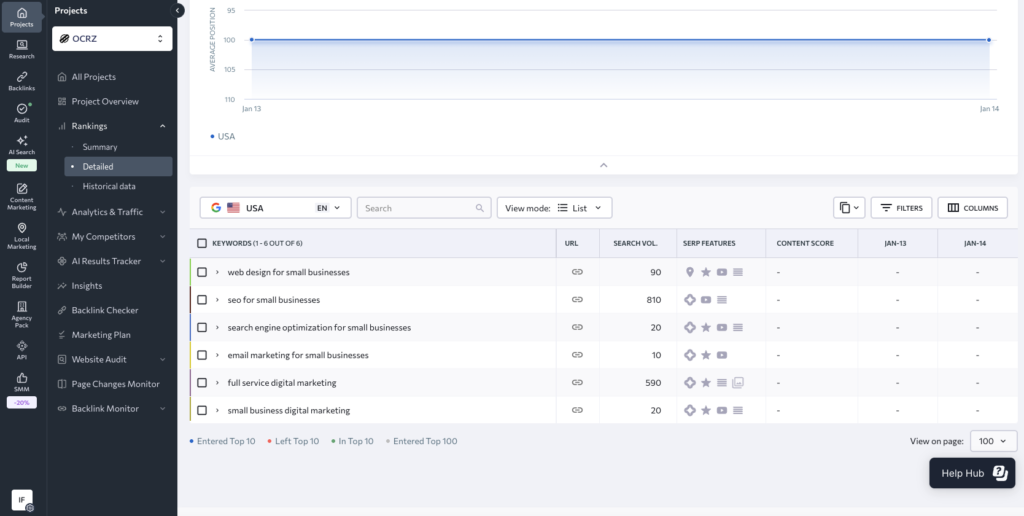
2. Keyword Difficulty (KD)
How hard is it to rank for this keyword?
SE Ranking shows KD scores 0-100:
- 0-20: Easy (target these first)
- 21-40: Medium (target after you have some authority)
- 41-60: Hard (need strong backlinks)
- 61-100: Very hard (avoid unless you’re established)
For new sites, focus on KD under 30.
Real Examples:
“coffee shop” → KD: 65 (very hard) “coffee shop with outdoor seating [your city]” → KD: 18 (easy!)
“hair salon” → KD: 70 (very hard) “balayage hair salon [your city]” → KD: 22 (doable!)
3. Search Intent
What is the searcher trying to do?
Four types of intent:
Informational (“how to make cold brew coffee”) → They want to learn → Target with educational blog posts → Lower conversion but builds authority
Commercial (“best hair salon for balayage”) → They’re researching before buying → Target with service pages and blog posts → Medium-high conversion
Transactional (“book haircut appointment”) → They’re ready to buy NOW → Target with service/booking pages → High conversion
Navigational (“starbucks near me”) → They want a specific brand → Usually not worth targeting
Local Intent (“coffee shop near me”) → They want something nearby → Target with local SEO and Google Business Profile → Very high conversion for local businesses
Action Step: In SE Ranking, filter keywords by:
- Search volume: 50-5,000 (adjust based on your market)
- Keyword difficulty: 0-30
- Export this filtered list
Step 4: Check SERP Reality (30 Minutes)
Keyword difficulty scores are helpful, but you need to see what’s actually ranking.
How to do SERP analysis in SE Ranking:
- Click on any keyword in your results
- View the SERP Analysis section
- Look at the top 10 results
Ask yourself:
Can I compete with these results?
Look at the top 10 and check:
- Are they all huge brands? (Starbucks, Great Clips, etc.)
- Are they established local businesses with lots of reviews?
- Are they old domains with thousands of backlinks?
- Or are they smaller businesses like yours?
Example – “coffee shop with wifi [your city]”:
If you see: ✅ Local blogs ✅ Small coffee shops ✅ Yelp/TripAdvisor listings → You can compete!
If you see: ❌ Starbucks ❌ Major chains ❌ National magazines → Too competitive, try more specific keywords
What type of content is ranking?
- Blog posts? (Write a blog post)
- Service pages? (Create a service page)
- List articles? (Write “10 Best Coffee Shops in [City]”)
- Location pages? (Create a location page)
Match your content to what’s already ranking.
Are the top results relevant?
Sometimes high KD keywords show irrelevant results. This is your opportunity.
Example: “cold brew” might show:
- How-to articles about making cold brew
- Cold brew products to buy
- Coffee shops serving cold brew
If you’re a coffee shop and the top results are how-to articles, you can rank by creating the BEST coffee shop page for cold brew.
Action Step: Review the SERPs for your top 20 keywords. Eliminate any where you clearly can’t compete.
Step 5: Group Keywords by Topic (20 Minutes)
Don’t create separate pages for every keyword variation. Group related keywords into topics.
Example – Coffee Shop:
Topic 1: “Coffee Shop with Wifi” Target keywords:
- coffee shop with wifi [city]
- coffee shops for working [city]
- coffee shop for studying [city]
- best coffee shop to work remotely [city]
One page targets all of these.
Topic 2: “Best Breakfast Coffee Shop” Target keywords:
- coffee shop breakfast [city]
- coffee shop with food [city]
- best breakfast coffee shop [city]
- coffee shop breakfast sandwich [city]
One page targets all of these.
Hair Salon Example:
Topic 1: “Balayage Hair Services” Target keywords:
- balayage hair salon [city]
- balayage hair color [city]
- best balayage [city]
- balayage specialist [city]
Topic 2: “Curly Hair Specialist” Target keywords:
- hair salon for curly hair [city]
- curly hair specialist [city]
- curly haircut [city]
- best salon for curly hair [city]
How SE Ranking Helps:
Use SE Ranking’s Keyword Grouper tool to automatically group related keywords by topic. It clusters keywords that can be targeted on the same page.
Action Step: Group your keywords into 10-20 topics. Each topic = one piece of content.
Step 6: Prioritize Your Keywords (15 Minutes)
You now have 10-20 topics. Which do you tackle first?
Prioritization Matrix:
Priority 1 – Quick Wins:
- Low competition (KD 0-20)
- Decent volume (100+ searches)
- High intent (transactional or commercial)
- Relevant to your best services
Priority 2 – Authority Builders:
- Medium competition (KD 21-35)
- Good volume (500+ searches)
- Informational intent
- Shows expertise
Priority 3 – Long-Term Plays:
- Higher competition (KD 36-50)
- High volume (1,000+ searches)
- Any intent
- Big money keywords
Start with Priority 1. Get quick wins, build authority, then tackle harder keywords.
Example Priority 1 Keywords for a Coffee Shop:
- “coffee shop with outdoor seating [city]” – KD: 18, Volume: 320
- “coffee shop open late [city]” – KD: 15, Volume: 210
- “coffee shop for studying [city]” – KD: 22, Volume: 180
Action Step: Rank your topics 1-20 by priority. Start creating content from #1.
Step 7: Spy on Your Competitors (30 Minutes)
Your competitors have already done keyword research. Why not learn from them?
Using SE Ranking’s Competitor Analysis:
- Go to Competitor Research → Organic Research
- Enter a competitor’s domain
- Click “Search”
What you’ll see:
- Every keyword they rank for
- Their ranking positions
- Traffic estimates
- Top pages
What to look for:
Keywords they rank for that you don’t: These are opportunities. If they can rank, you can too.
Keywords where they rank in positions 4-10: If they’re not dominating, you can beat them with better content.
Their top traffic pages: These pages drive most of their traffic. Create something better targeting the same keywords.
Example – Analyzing a Competing Coffee Shop:
You discover they rank #3 for “coffee shop with vegan options [city]” with a simple 300-word page.
Your opportunity: Create a comprehensive 1,500-word page about your vegan options with:
- Photos of every vegan item
- Ingredient lists
- Customer testimonials
- Comparison to other local options
You’ll outrank them.
Action Step: Analyze 3-5 competitors. Add any valuable keywords they rank for to your list.
Step 8: Track Your Rankings (Ongoing)
Once you create content, track how it performs.
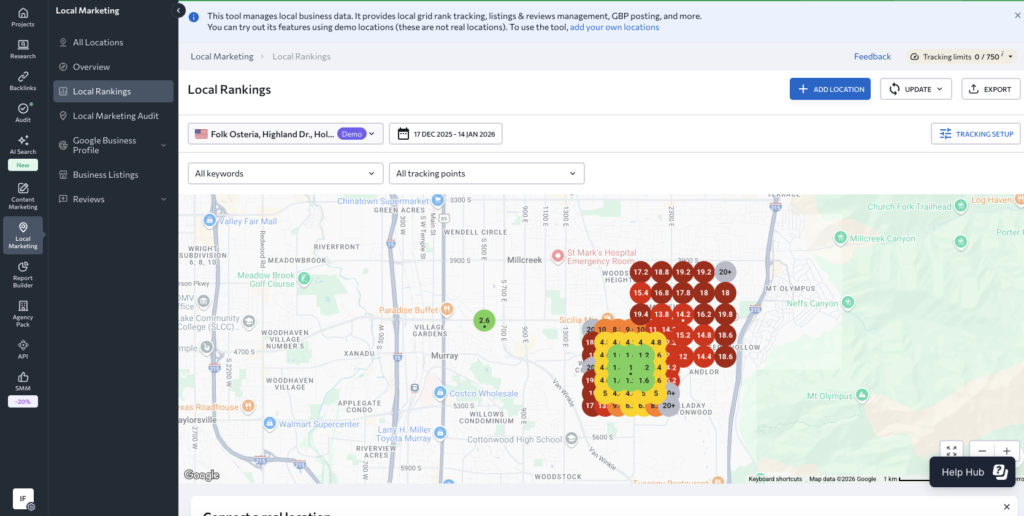
SE Ranking’s Rank Tracking:
- Go to Rankings → Add Project
- Enter your domain
- Add your target keywords (SE Ranking Pro plan = unlimited tracking)
- Select your location (city-level for local businesses)
- Set tracking frequency (I recommend daily)
What to monitor:
- Keyword position – Are you moving up?
- Search visibility – Overall SEO performance
- Competitor positions – Who’s beating you?
- SERP features – Are you appearing in featured snippets, local pack, etc.?
When to update content:
If a page ranks positions 5-20, update it:
- Add more content
- Improve formatting
- Add images/video
- Build backlinks
Small improvements often push you to page 1.
SE Ranking tracks unlimited keywords on the Pro plan →
Real-World Examples: Keyword Research in Action
Example 1: Local Coffee Shop

Business: Independent coffee shop in San Francisco, CA.
Starting Point: No SEO, relying on foot traffic
Keyword Research Process:
Step 1: Seed Keywords
- coffee shop
- espresso
- cold brew
- breakfast
- wifi
Step 2: Expansion (using SE Ranking) Found 340 related keywords
Step 3: Filtered to:
- KD under 25
- Volume 50-1,000
- Local intent
- 23 target keywords identified
Step 4: Grouped into 5 topics:
- “Coffee shop with wifi for remote work”
- “Best breakfast coffee shop”
- “Coffee shop with outdoor seating”
- “Late night coffee shop”
- “Coffee shop meeting space”
Step 5: Created content:
- 5 blog posts targeting each topic
- Updated service pages with keywords
- Optimized Google Business Profile
Results after 4 months:
- 0 → 1,240 monthly organic visitors
- Ranking #1-3 for 18/23 target keywords
- 37% increase in walk-in traffic
- $8,400 additional monthly revenue attributed to SEO
Example 2: Hair Salon

Business: Hair salon in San Diego, CA
Challenge: Competing with 50+ other salons in the area
Keyword Research Process:
Step 1: Used SE Ranking to find:
- 180 relevant keywords
- Focused on specific services (not just “hair salon”)
Step 2: Identified opportunities:
- “balayage hair salon san diego” – KD: 19
- “curly hair specialist san diego” – KD: 22
- “hair extensions san diego” – KD: 28
- “men’s haircut downtown san diego” – KD: 15
Step 3: Created service-specific pages: Each page targeted one service + local modifiers
Step 4: Added schema markup (using SE Ranking’s guidance)
Results after 6 months:
- 120 → 2,100 monthly organic visitors
- 45% increase in online bookings
- $12,000 additional monthly revenue
- Ranking #1-5 for 12 high-intent keywords
Common Keyword Research Mistakes (And How to Avoid Them)
Mistake #1: Targeting Keywords That Are Too Broad
Wrong: “coffee” (KD: 92, impossible to rank) Right: “specialty coffee shop [your city]” (KD: 18, rankable)
Broad keywords are dominated by massive brands. Go specific.
Mistake #2: Ignoring Search Intent
You rank #1 for “how to cut hair at home” but you’re a salon. Wrong intent.
Match your content to what searchers want:
- Informational intent → Educational content
- Commercial intent → Service pages, reviews
- Transactional intent → Booking pages, product pages
Mistake #3: Only Targeting High Volume Keywords
“coffee shop” = 50,000 searches (KD: 78) “coffee shop with meeting room [city]” = 90 searches (KD: 12)
You’ll get more traffic faster from 10 low-volume, low-competition keywords than one high-volume keyword you can’t rank for.
Mistake #4: Creating Separate Pages for Similar Keywords
Don’t create:
- Page 1: “coffee shop with wifi”
- Page 2: “coffee shop for working”
- Page 3: “coffee shop to study”
These are the same topic. One comprehensive page ranks for all of them.
Mistake #5: Not Tracking Results
If you don’t track rankings, you don’t know what’s working.
Use SE Ranking to monitor:
- Which keywords are improving
- Which content needs updates
- Where competitors are beating you
Advanced Keyword Research Tactics
Once you’ve mastered the basics, try these advanced strategies:
Tactic #1: Target Featured Snippets
SE Ranking shows which keywords have featured snippets.
Target these with:
- Direct answers to questions
- Numbered lists
- Tables and comparisons
Featured snippets = position #0, above #1.
Tactic #2: Seasonal Keywords
Coffee shop examples:
- “iced coffee” (peaks in summer)
- “pumpkin spice latte” (peaks in fall)
- “peppermint mocha” (peaks in winter)
Create content 2-3 months before the season. It’ll be ranking when demand hits.
Tactic #3: “Near Me” Optimization
“coffee shop near me” = huge volume, high intent
To rank:
- Optimize Google Business Profile
- Add location schema to website
- Create location-specific pages
- Get local citations
Tactic #4: Gap Analysis
SE Ranking’s Competitive Research shows keywords competitors rank for that you don’t.
Find gaps, fill them, outrank them.
Tactic #5: Topic Clusters
Create a pillar page for a broad topic: “The Complete Guide to Coffee”
Then create cluster content:
- “Types of Espresso Drinks”
- “How to Make Cold Brew”
- “Best Coffee Beans for Lattes”
Link them all together. Google rewards comprehensive topic coverage.
Your 30-Day Keyword Research Action Plan
Week 1: Research
- Day 1-2: Brainstorm seed keywords
- Day 3-4: Use SE Ranking to expand keywords
- Day 5-7: Analyze metrics and SERP reality
Week 2: Strategy
- Day 8-10: Group keywords into topics
- Day 11-12: Prioritize keywords
- Day 13-14: Analyze competitors
Week 3: Content Creation
- Day 15-21: Create content for your top 3 Priority 1 keywords
Week 4: Optimization & Tracking
- Day 22-24: Optimize existing pages with new keywords
- Day 25-27: Set up rank tracking in SE Ranking
- Day 28-30: Create content calendar for next 10 topics
Tools Checklist
Must-Have: ✅ SE Ranking – Keyword research, rank tracking, competitor analysis
Free Supplements: ✅ Google Search Console – See what you already rank for ✅ Google Business Profile – Local SEO tracking ✅ Google Trends – Seasonal trends and related queries
Nice to Have:
- Answer the Public – Question-based keywords (limited free tier)
- Google Keyword Planner – Free but less accurate than paid tools
My Recommendation:
Start with SE Ranking’s 14-day free trial. You can do 80% of your keyword research during the trial period if you’re focused.
Try SE Ranking free for 14 days →
If you decide to continue (which you probably will once you see the data), the Pro plan at $119/month gives you unlimited keyword tracking and is still cheaper than competitors.
Frequently Asked Questions About Keyword Research For Small Businesses
The Bottom Line
Keyword research isn’t complicated—it’s just systematic.
Follow this process:
- Brainstorm seed keywords (15 min)
- Expand with SE Ranking (30 min)
- Filter by metrics (45 min)
- Check SERP reality (30 min)
- Group by topic (20 min)
- Prioritize (15 min)
- Spy on competitors (30 min)
- Track rankings (ongoing)
Total time investment: 3-4 hours of focused work
Potential return: Thousands of monthly visitors and customers
The businesses winning with SEO aren’t smarter than you. They just do keyword research before creating content instead of after.
Stop guessing what to write about. Use data.
Start your SE Ranking free trial →
Do your keyword research this week. Create content next week. Get traffic next month.
It’s that simple.
Related Articles:
Disclosure: This article contains affiliate links. If you purchase SE Ranking through my links, I may earn a commission at no additional cost to you. I only recommend tools I personally use and believe provide genuine value. All keyword research examples and results are based on real client work.

Similar Software to SEO Clarity: Affordable Alternatives for Small Businesses
If you’re searching for similar software to SEO Clarity, chances are you’ve just experienced serious…
Best SEMrush Alternatives in 2026: Affordable SEO Tools That Actually Work
If you’re searching for the best SEMrush alternatives, you’re probably experiencing one of two things:…
Hotel Email Marketing Software: Why Sender.net is the Perfect Solution for Hotels
Summary: Looking for reliable hotel email marketing software? Sender.net offers hotels everything needed to automate…

How Do I Get More Customers? 10 Proven Strategies for Small Businesses in 2026
Summary: Wondering: “How Do I Get More Customers in 2026?” This comprehensive guide reveals 10…

Best Website Builder for Nonprofit Organizations: Free and Discounted Options in 2026
Summary: Nonprofits operate on tight budgets, making expensive website builders impractical. This guide reviews the…

Best SEO Software for Small Businesses: Tools That Actually Deliver Results in 2026
Summary: Choosing the right SEO software can transform your small business’s online visibility, but with…