
Summary: Looking for effective SEO for architectural firms? This comprehensive guide shows architecture firms how to dominate Google search results, attract qualified clients, and grow their business through strategic search engine optimization. From local SEO for architects to portfolio optimization and digital marketing for architecture firms, discover proven strategies that deliver measurable results in competitive markets like San Francisco and the Bay Area.
Last updated: January 21, 2026
What Is SEO For Architectural Firms?
Finding quality clients consistently represents one of the biggest challenges facing architectural firms today. While referrals and portfolio websites help, they’re not enough in an increasingly digital marketplace where potential clients begin their architect search on Google & other search engines.
SEO for architectural firms transforms how design-focused businesses attract clients by ensuring your firm appears when homeowners, developers, and commercial clients search for architectural services. Whether prospects search “residential architect near me,” “commercial architecture firm San Francisco,” or “sustainable design architects,” strategic search optimization puts your firm in front of decision-makers at the exact moment they need your services.
This guide reveals the complete SEO for architecture firms strategy—from keyword research and local visibility to portfolio optimization and content marketing. You’ll discover how to outrank competitors, attract higher-quality leads, and build a sustainable client acquisition system that reduces dependence on referrals and cold outreach.
Why SEO Matters for Architectural Firms
The architecture industry has fundamentally changed. Potential clients no longer rely solely on personal recommendations or industry directories to find design professionals. Research shows that 97% of consumers search online before hiring professional services, and digital marketing for architecture firms has become essential rather than optional.
SEO for architects delivers several critical business advantages:
Consistent lead generation. Optimized firms receive qualified inquiries every week without expensive advertising or constant networking. When your firm ranks on Google’s first page for relevant searches, prospects find you automatically.
Higher-quality clients. People who find architectural firms through search already have specific project needs and budget parameters. They’re researching solutions, not browsing casually. This intent-driven traffic converts at significantly higher rates than cold outreach.
Reduced client acquisition costs. Once established, organic search visibility costs substantially less than paid advertising, referral fees, or business development efforts. Your website works 24/7 attracting prospects without ongoing advertising spend.
Competitive positioning. First-page Google rankings establish immediate credibility and authority. Firms appearing in top search results benefit from perceived expertise and trustworthiness before prospects even visit their website.
Geographic targeting precision. Local SEO for architects ensures your firm appears for location-specific searches like “architectural firm Oakland” or “residential architect Palo Alto.” This geographic precision attracts clients in your service areas while filtering out irrelevant inquiries from distant locations.
Specialization visibility. Whether you focus on sustainable design, historic renovation, commercial development, or luxury residential projects, SEO allows targeting specific architecture niches. This specialization attracts ideal clients seeking your particular expertise.
The architecture firms dominating search results aren’t necessarily the largest or most established—they’re the ones implementing comprehensive SEO strategies. While competitors rely on inconsistent referrals, optimized firms enjoy predictable inquiry flow month after month.

Understanding How Clients Search for Architectural Services
Effective SEO for architectural firms begins with understanding client search behavior. Different project types and client sophistication levels generate distinct search patterns, and your optimization strategy must address these varied search intents.
Residential clients typically search using terms like:
- “residential architect [city name]”
- “custom home designer near me”
- “architect for home addition”
- “modern house architect San Francisco”
- “how to find a good architect”
These searchers often represent first-time architecture clients researching the process, evaluating options, and comparing firms. Content addressing their questions and concerns captures attention during critical decision-making phases.
Commercial clients and developers search more specifically:
- “commercial architecture firm Bay Area”
- “office building architect San Francisco”
- “multi-family residential architect”
- “retail space designer [location]”
- “sustainable commercial architecture”
Commercial searches indicate higher project values and more sophisticated buyers who understand architecture services. These searchers evaluate technical capabilities, past projects, and specialized expertise.
Location-based searches dominate local architecture inquiries:
- “architect near me”
- “San Francisco architecture firm”
- “best architect in Oakland”
- “Marin County residential architect”
Local SEO for architects captures these high-intent searches by optimizing Google Business Profile, building local citations, and creating location-specific content. Geographic optimization proves especially valuable for firms serving defined service areas.
Project-type searches reflect specific needs:
- “kitchen addition architect”
- “historic home renovation architect”
- “passive house architect”
- “ADU designer San Francisco”
- “LEED certified architect”
Creating dedicated service pages targeting these project-specific searches positions your firm as the specialist solution rather than generalist alternative.
Informational searches indicate early research phases:
- “how much does an architect cost”
- “do I need an architect for renovation”
- “architect vs designer difference”
- “what does an architect do”
Blog content and educational resources addressing these questions build trust, demonstrate expertise, and capture prospects early in their decision journey. When these researchers become ready to hire, your firm has already established credibility and top-of-mind awareness.
Understanding this search diversity allows creating comprehensive digital marketing for architecture firms that captures prospects throughout their entire decision process—from initial research through final selection.
Local SEO for Architects: Dominating Your Geographic Market
For most architectural firms, local visibility determines business success. Clients typically hire architects within specific geographic areas due to licensing requirements, building code knowledge, site visit practicality, and preference for local expertise.
Local SEO for architects focuses on maximizing visibility in location-based searches and Google’s local map pack—the three listings appearing above organic results for local queries. Appearing in this coveted map pack generates significant qualified traffic and positions your firm as a top local choice.
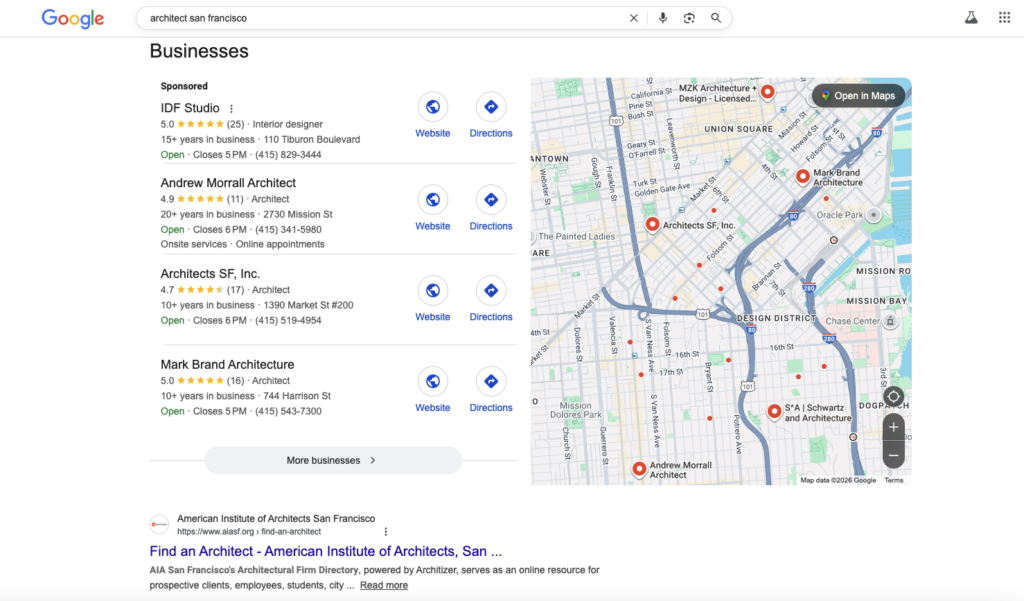
Optimizing Google Business Profile for Architecture Firms
Your Google Business Profile (formerly Google My Business) represents the single most important local SEO for architects asset. Complete, accurate, and actively managed profiles significantly outperform neglected competitors.
Complete every profile section comprehensively:
Set your primary category as “Architect” and add secondary categories like “Architecture Firm,” “Building Design Company,” or specialization categories relevant to your services. Choose categories carefully as they directly influence which searches display your profile.
Write a compelling business description incorporating primary keywords naturally while clearly communicating your firm’s unique value proposition, service areas, and specializations. Include “architectural firm,” “architecture services,” and location names strategically without keyword stuffing.
Add detailed service listings for each architecture service type you offer—residential design, commercial architecture, interior design, sustainable architecture, historic renovation, etc. Comprehensive service listings improve relevance for diverse search queries.
Upload high-quality photos regularly showcasing completed projects, office environment, team members, design process, and site visits. Profiles with 100+ photos receive significantly more engagement and clicks than sparse profiles. Architecture is visual—demonstrate your design excellence through exceptional imagery.
Post weekly updates sharing project completions, design insights, awards, industry news, or client testimonials. Regular posting signals active business operations and provides fresh content that can appear in search results.
Collect and respond to Google reviews systematically:
Reviews dramatically influence local search rankings and client decisions. Implement systematic review collection by requesting feedback from satisfied clients after project milestones or completion.
Respond to every review—positive and negative—professionally and personally. Thoughtful responses demonstrate client commitment and provide opportunities to incorporate keywords naturally (e.g., “Thank you for trusting our architectural firm with your Noe Valley residence renovation”).
Building Local Citations and Directory Listings

Citations—mentions of your firm’s name, address, and phone number across the web—strengthen local SEO authority. Consistency across citations signals legitimacy to search engines.
List your architectural firm in:
- Industry-specific directories (Houzz, ArchDaily, Architizer, Dwell Professionals)
- Local business directories (Yelp, Yellow Pages, Chamber of Commerce)
- Professional associations (AIA chapters, state architecture boards)
- Local media and community sites
Ensure NAP (Name, Address, Phone) information matches exactly across all listings. Even minor variations (Ave vs Avenue, Suite vs Ste) can dilute citation value.
Creating Location-Specific Content
Develop dedicated pages or blog content targeting specific cities, neighborhoods, or regions you serve. Location pages should provide genuine value—not thin content created solely for SEO.
Effective location pages include:
- Area-specific design considerations (local climate, architectural styles, zoning regulations)
- Completed projects in that location with detailed case studies
- Local building code expertise and permitting knowledge
- Community involvement and local partnerships
- Unique architectural characteristics of the region
For Bay Area architectural firms, create separate pages optimizing for San Francisco, Oakland, Berkeley, Palo Alto, Marin County, and other key service areas. Each page should target location-specific keywords like “architect San Francisco” or “architectural firm Oakland.”
Keyword Research and Strategy for Architecture SEO
Effective SEO for architecture firms requires strategic keyword targeting that balances search volume, competition, and commercial intent. Architecture-related keywords typically have moderate search volumes compared to broader industries, but lower competition and higher conversion rates compensate for smaller traffic numbers.
Primary Architecture Keywords
Target core service keywords that directly describe your offerings:
“Architectural firm [location]” – High intent, moderate competition, excellent for firms serving specific markets. Commercial intent is strong as searchers explicitly seek professional firms.
“SEO for architects” – Captures professionals seeking marketing services (if you offer architecture marketing consulting) or indicates research into how clients find architects online.
“Architect [location]” – Broad, competitive, but essential. High search volume justifies optimization effort despite difficulty.
“Residential architect [location]” – More specific, indicates clear service need. Lower competition than generic “architect” searches.
“Commercial architecture firm” – Signals higher project values and sophisticated clients. Worth targeting for firms serving commercial markets.
Long-Tail Architecture Keywords
Long-tail keywords—longer, more specific phrases—capture qualified prospects with defined needs:
- “sustainable architecture firm San Francisco”
- “historic home renovation architect”
- “LEED certified architect Bay Area”
- “ADU designer Oakland”
- “passive house architect”
- “mid-century modern renovation architect”
These specialized phrases have lower search volumes but convert exceptionally well because searchers have specific project parameters matching your expertise.
Informational Keywords for Content Marketing
Educational content targeting informational keywords builds authority and captures early-stage prospects:
- “how to choose an architect”
- “architect fees and costs”
- “do I need an architect for renovation”
- “architect vs designer”
- “what to expect when working with an architect”
Blog posts and resource pages targeting these topics demonstrate expertise, answer common questions, and establish trust with prospects still researching their options.
Competitor Keyword Analysis
Analyze successful competitor websites to identify valuable keyword opportunities. Tools like Ahrefs, SEMrush, or Moz reveal which keywords drive traffic to competing architectural firms.
Look for:
- Keywords competitors rank for that you don’t
- Lower-difficulty keywords competitors haven’t optimized
- Content gaps where no competitors provide comprehensive information
- Local keywords competitors neglect
This competitive intelligence reveals proven keyword opportunities and content topics that attract your target audience.

Optimizing Your Architecture Website for Search Engines
Technical website optimization ensures search engines can crawl, understand, and properly rank your architecture firm’s site. While digital marketing for architecture firms encompasses many strategies, on-page SEO forms the foundation of search visibility.
Website Structure and Navigation
Organize your architecture website with clear, logical hierarchy that helps both users and search engines understand your services and expertise.
Primary navigation should include:
- Services (with dropdown for specific architecture types)
- Portfolio/Projects
- About/Our Process
- Blog/Resources
- Contact
Create dedicated service pages for each architecture offering rather than listing all services on one page. Separate pages for residential architecture, commercial architecture, sustainable design, historic renovation, interior architecture, and other specializations allow targeting specific keywords effectively.
On-Page SEO Elements
Optimize critical on-page elements for target keywords:
Title tags should include primary keywords and location. Format as “Service + Location + Brand” (e.g., “Residential Architect San Francisco | [Your Firm Name]”). Keep titles under 60 characters to avoid truncation in search results.
Meta descriptions should compellingly summarize page content while incorporating keywords naturally. While not directly influencing rankings, persuasive meta descriptions improve click-through rates from search results. Include calls-to-action and unique value propositions.
Header tags (H1, H2, H3) structure content hierarchically and signal topic relevance to search engines. Use one H1 per page incorporating the primary keyword. H2 and H3 tags should include keyword variations and related terms naturally.
URL structure should be clean, descriptive, and keyword-rich. Use “/residential-architecture-san-francisco/” rather than “/page-id-1234/”. Hyphens separate words, and shorter URLs perform better than lengthy ones.
Internal linking connects related pages and distributes ranking authority throughout your site. Link from service pages to relevant portfolio projects, from blog posts to service pages, and from location pages to related content. Use descriptive anchor text rather than “click here.”
Image Optimization for Architecture Websites
As visual businesses, architectural firms depend on exceptional photography and renderings to showcase their work. Proper image optimization makes this visual content discoverable in Google Image Search while improving page load speed.
File names should be descriptive and keyword-rich before uploading. Rename “IMG_1234.jpg” to “modern-residential-architecture-san-francisco.jpg” to provide context about image content.
Alt text describes images for screen readers and search engines. Write concise, accurate descriptions incorporating relevant keywords naturally: “Contemporary kitchen design with floor-to-ceiling windows in Oakland residence by [Firm Name].”
Image compression reduces file sizes without visible quality loss, improving page load speed—a confirmed ranking factor. Use tools like TinyPNG, ImageOptim, or ShortPixel to compress images before uploading.
Responsive images adapt to different screen sizes, ensuring fast load times on mobile devices where most searches occur. Modern website platforms handle this automatically, but verify implementation.
Portfolio galleries represent prime opportunities for image SEO. Each project should have detailed alt text, descriptive file names, and accompanying text explaining project details, challenges solved, and design approach.
Mobile Optimization and Page Speed
Mobile-friendliness is essential for SEO for architectural firms since Google uses mobile-first indexing—evaluating mobile versions of websites primarily for ranking purposes.
Ensure your architecture website:
- Displays properly on all screen sizes and devices
- Uses readable font sizes without requiring zooming
- Spaces interactive elements appropriately for touch navigation
- Avoids horizontal scrolling or content cutoff
Page speed significantly impacts both rankings and user experience. Architecture websites with extensive imagery must balance visual quality with load performance.
Improve page speed by:
- Compressing images without sacrificing visual quality
- Implementing lazy loading for images below the fold
- Minifying CSS and JavaScript files
- Using browser caching
- Choosing quality hosting with adequate server resources
- Implementing a Content Delivery Network (CDN) for faster global access
Test mobile usability and page speed using Google’s Mobile-Friendly Test and PageSpeed Insights tools. Address identified issues to ensure optimal technical performance.
Content Marketing for Architecture Firms
Strategic content creation establishes expertise, answers prospect questions, and generates organic traffic from informational searches. Digital marketing for architecture firms succeeds when educational content builds trust before prospects need to hire.

Architecture Blog Topics That Attract Clients
Regular blog publishing demonstrates active expertise and provides fresh content that search engines favor. Focus on topics addressing client questions, concerns, and interests:
Project process education:
- “What to Expect: The Architecture Design Process from Concept to Completion”
- “How Long Does It Take to Design a Custom Home?”
- “Understanding Architecture Fees: How Architects Charge for Services”
Design trends and inspiration:
- “Sustainable Design Trends Transforming Bay Area Architecture”
- “Mid-Century Modern Renovation: Preserving Character While Adding Function”
- “Small Space Solutions: Maximizing Square Footage in Urban Homes”
Practical advice and decision guides:
- “Hiring an Architect: 10 Questions to Ask Before Signing a Contract”
- “Do You Need an Architect for Your Home Renovation?”
- “Architect vs. Designer vs. Contractor: Understanding the Differences”
Local market insights:
- “Navigating San Francisco Building Codes for Residential Additions”
- “ADU Design in Oakland: Regulations, Costs, and Considerations”
- “Historic Preservation Requirements for Bay Area Home Renovations”
Case studies and project stories:
- “Transforming a 1920s Berkeley Craftsman for Modern Living”
- “Sustainable Office Design: LEED Platinum Certification Case Study”
- “Hillside Home Design: Engineering Solutions for Challenging Sites”
Publish consistently—weekly or bi-weekly—rather than sporadically. Search engines reward regular publishing schedules, and frequent content keeps your firm visible in prospects’ awareness.
Video Content and Visual SEO
Architecture’s visual nature makes video content particularly effective for engagement and SEO. Video content increases time-on-site metrics and provides additional ranking opportunities through YouTube optimization.
Create video content showing:
- Project tours and walkthroughs
- Design process explanations
- Client testimonials and project stories
- Architectural detail highlights
- Design philosophy and approach
Optimize video content for search by:
- Creating descriptive, keyword-rich titles
- Writing detailed video descriptions with timestamps
- Adding accurate transcripts for accessibility and keyword context
- Creating custom thumbnails that encourage clicks
- Embedding videos on relevant website pages
Video content shared on YouTube and embedded on your architecture website creates multiple touchpoints for prospect discovery while diversifying your content portfolio beyond text and images.
Building Authority Through Digital PR
Earning mentions and links from authoritative architecture and design publications strengthens SEO authority and drives referral traffic.
Target opportunities including:
- Submitting projects to ArchDaily, Architizer, Dezeen, Dwell
- Contributing expert commentary to design publications
- Partnering with design bloggers on project features
- Participating in architecture competitions and award programs
- Speaking at industry conferences and events
Each published feature, award recognition, or expert contribution generates valuable backlinks—links from other websites to yours—that signal authority to search engines. Quality backlinks from respected architecture and design sites significantly boost search rankings.
Platform and Directory Optimization for Architects
Beyond your website, architecture-specific platforms and directories provide additional visibility and backlink opportunities. Profile optimization on these platforms strengthens overall SEO for architects while reaching prospects who discover architects through these specialized channels.
Houzz Optimization
Houzz represents one of the most important platforms for residential architectural firms. Millions of homeowners use Houzz to research design ideas and find professionals.
Optimize your Houzz profile by:
- Completing every profile section with keyword-rich descriptions
- Uploading extensive project photos with detailed descriptions
- Requesting and responding to client reviews
- Answering questions in relevant discussion forums
- Publishing regular ideabooks showcasing your expertise
- Maintaining Houzz Pro subscription for enhanced features
Active Houzz profiles generate direct client inquiries while providing valuable backlinks to your main website. Many clients discover architects through Houzz project browsing before visiting firm websites.
ArchDaily and Architizer
ArchDaily and Architizer cater to design professionals and educated clients seeking exceptional architecture. These platforms provide exposure to sophisticated audiences and valuable backlinks from high-authority domains.
Submit your best projects with:
- Professional photography showcasing design excellence
- Comprehensive project descriptions explaining challenges and solutions
- Technical details and sustainable features
- Site context and design philosophy
Featured projects on these platforms generate significant exposure within the architecture community and attract commercial clients seeking design-forward firms.
Professional Association Profiles
Memberships in professional organizations like the American Institute of Architects (AIA) include directory listings that boost local SEO through quality citations and backlinks.
Optimize association profiles by:
- Ensuring accurate, consistent NAP information
- Including comprehensive service descriptions
- Linking to your main website
- Highlighting awards, certifications, and specializations
- Updating profiles when winning awards or completing notable projects
These professional directory listings contribute to local search authority while demonstrating credibility through association membership.
Measuring and Improving SEO Performance
Effective SEO for architectural firms requires consistent monitoring, analysis, and optimization. Tracking key metrics reveals what’s working, identifies improvement opportunities, and justifies marketing investment.

Essential SEO Metrics for Architecture Firms
Monitor these critical performance indicators:
Organic search traffic measures visitors arriving from non-paid search results. Increasing organic traffic indicates improving search visibility and successful keyword targeting.
Keyword rankings track positions for target keywords. Monitor primary terms like “architectural firm [your city]” and “residential architect [location]” plus long-tail variations. Rankings fluctuate, so evaluate trends over months rather than daily changes.
Conversion rate measures the percentage of visitors completing desired actions—contact form submissions, phone calls, consultation bookings. Architecture firms typically see 2-5% conversion rates; optimized sites achieve higher rates through compelling calls-to-action and clear value propositions.
Bounce rate indicates the percentage of visitors leaving after viewing only one page. High bounce rates (above 60%) suggest misalignment between search intent and page content or poor user experience. Architecture websites should aim for bounce rates below 50%.
Pages per session and average session duration reveal engagement quality. Prospects researching architectural services should view multiple pages and spend several minutes exploring portfolios and service information.
Lead quality matters more than pure lead volume. Track which keywords and pages generate highest-quality prospects—those matching your ideal client profile and converting to actual projects.
SEO Tools for Tracking Architecture Firm Performance
Google Analytics provides comprehensive traffic analysis including source tracking, user behavior, conversion monitoring, and audience demographics. Configure goal tracking for form submissions, phone calls, and other conversion actions.
Google Search Console reveals search performance data including keyword impressions, clicks, average position, and click-through rates. Identify keywords driving traffic, monitor indexing status, and discover technical issues affecting search visibility.
Rank tracking tools (Ahrefs, SEMrush, Moz) monitor keyword positions, analyze competitor rankings, and identify new keyword opportunities. Track local rankings specifically as they differ from national results.
Heatmapping tools (Hotjar, Crazy Egg) visualize user behavior on your site, showing where visitors click, how far they scroll, and which portfolio projects attract most attention. This insight guides design and content optimization.
Continuous Optimization Strategies
SEO requires ongoing refinement rather than set-it-and-forget-it implementation:
Content expansion – Regularly add new blog posts, portfolio projects, and service pages. Fresh content signals active business operations and provides more entry points for organic traffic.
Content updates – Revisit existing pages quarterly to update information, add new keywords naturally, improve readability, and enhance calls-to-action. Updated content often receives ranking boosts.
Technical audits – Conduct quarterly technical SEO audits identifying broken links, crawl errors, duplicate content, missing meta tags, and page speed issues. Address problems promptly.
Backlink building – Consistently pursue quality backlink opportunities through project submissions, guest contributions, and relationship building with design publications.
Local SEO maintenance – Keep Google Business Profile current with new photos, posts, and service updates. Systematically collect reviews and maintain citation consistency.
Conversion optimization – Test different calls-to-action, contact form placements, and landing page designs. Small improvements in conversion rate significantly impact lead generation without requiring more traffic.
Common SEO Mistakes Architecture Firms Make
Avoid these prevalent SEO for architecture firms mistakes that undermine search performance:
Portfolio-only websites with minimal text content. While visual portfolios showcase design excellence, search engines need text content to understand services, expertise, and location. Balance stunning imagery with substantive written content explaining your approach, services, and unique value.
Generic, non-specific service descriptions. Phrases like “We offer comprehensive architectural services” provide no keyword targeting or differentiation. Be specific: “Our San Francisco residential architecture firm specializes in sustainable custom home design and mid-century modern renovations.”
Neglecting local SEO entirely. Many architecture firms focus on aesthetic website design while ignoring Google Business Profile optimization, citation building, and location-specific content. Local search generates the highest-intent traffic for most firms.
Inconsistent or abandoned blogging. Starting a blog enthusiastically then abandoning it after a few posts signals inactive businesses to both prospects and search engines. Commit to sustainable publishing schedules you can maintain consistently.
Ignoring mobile users. Architects often design websites on desktop computers and optimize for large-screen viewing while neglecting mobile experience. With mobile searches dominating, mobile-unfriendly sites severely limit visibility.
Slow-loading image-heavy pages. Uncompressed high-resolution photography creates beautiful presentations but terrible user experiences. Properly optimized images maintain visual quality while loading quickly.
Missing or poor-quality alt text. Architecture websites contain hundreds of images with no descriptive alt text, missing massive image search opportunities. Every project photo should have detailed, keyword-rich alt text.
Duplicate content across project pages. Using identical descriptions for multiple projects or copying manufacturer specifications without adding original analysis creates duplicate content that search engines may filter from results.
No tracking or measurement. Implementing SEO tactics without tracking results prevents knowing what works. Install analytics, monitor performance, and make data-driven optimization decisions.
FAQ: SEO for Architectural Firms
Partner With Us For SEO For Architectural Firms
Growing your architectural firm through strategic search optimization requires specialized expertise in both SEO best practices and the unique dynamics of architecture industry marketing.
OCRZ Digital Marketing serves San Francisco Bay Area architectural firms with customized SEO for architectural firms strategies that generate qualified leads, increase visibility, and deliver measurable ROI. Our team understands the architecture industry’s distinct marketing challenges—long sales cycles, high project values, visual content dependence, and competitive local markets.
We deliver comprehensive services including:
- Technical SEO audits and optimization identifying and fixing issues limiting search visibility
- Local SEO strategies dominating Google’s local map pack for your service areas
- Keyword research and strategy targeting searches your ideal clients actually use
- Content marketing establishing expertise through valuable blog posts and resources
- Portfolio and image optimization making your visual content discoverable
- Google Business Profile management maximizing local search presence
- Citation building and directory optimization strengthening local authority
- Backlink acquisition earning quality links from authoritative architecture and design sites
- Performance tracking and reporting demonstrating ROI through clear metrics
Our digital marketing for architecture firms approach combines SEO with complementary strategies—website optimization, social media management, and paid advertising—creating comprehensive marketing systems that deliver consistent results.
Interested In SEO For your Small Business? Contact Us!